
How Sound and Vibration Influence the Human Nervous System
- carriek30
- Mar 15
- 10 min read
Introduction: Why Sound Affects the Body
Human beings live in a world of vibration. Every sound we hear is created by oscillating energy moving through air, water, or physical structures. From the rhythm of the heartbeat to the electrical activity of the brain, the human body itself functions through patterns of movement and frequency.
Because of this, the body is highly responsive to sound.
Across many cultures and traditions, sound has been used for centuries as a way to calm the mind, focus attention, and restore balance in the body. Bells, chanting, drumming, and tonal instruments have long been part of healing and spiritual practices. Today, growing scientific curiosity about the nervous system is helping to explain why these methods can influence our physiological state.
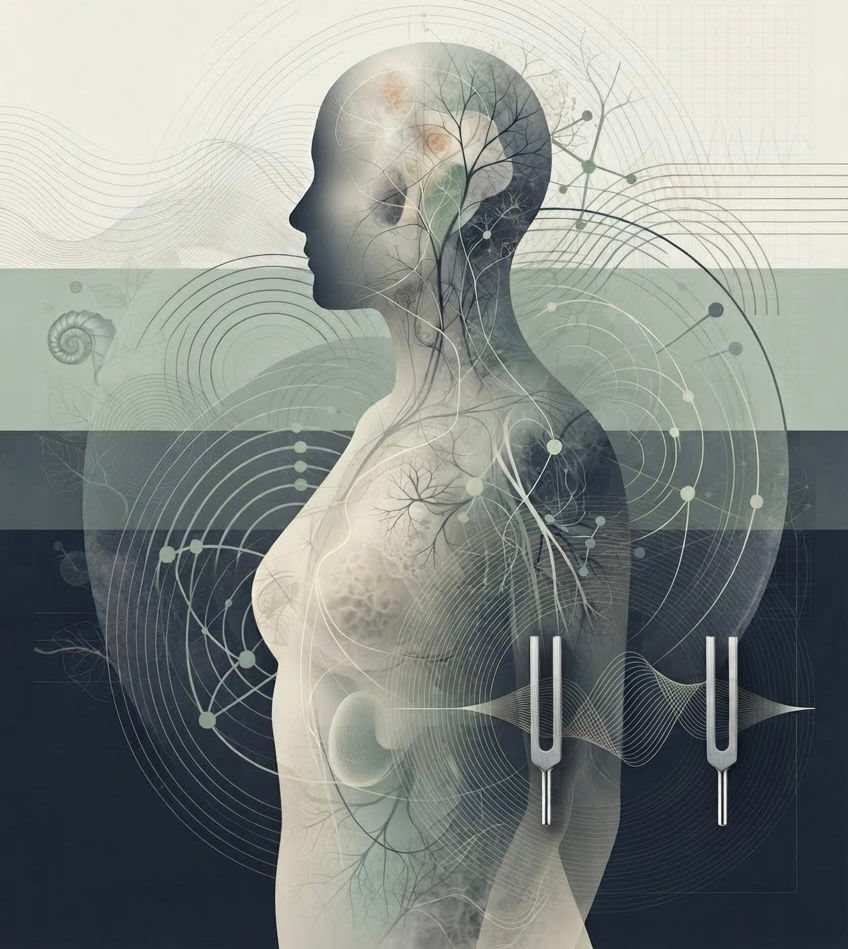
One modern tool used within sound therapy is the tuning fork. These simple instruments produce precise frequencies and stable vibrations that interact with the body through both hearing and physical sensation. By working with sound and vibration in this way, practitioners aim to support the body’s natural regulatory systems.
At the centre of this process lies the nervous system — the complex network that coordinates sensation, movement, emotion, and internal bodily functions. Understanding how sound interacts with the nervous system helps bridge the gap between traditional healing practices and modern scientific inquiry.

Key Concepts in Sound and Nervous System Regulation
Before exploring the mechanisms in detail, it is useful to understand several core concepts that describe how sound interacts with the body.
Sound is a form of mechanical vibration that travels through air, water, and biological tissue.
The human nervous system responds to sound through both auditory perception and physical vibration sensed by specialised receptors in the body.
Resonance occurs when one vibrating system stimulates another system to oscillate at a compatible frequency.
Entrainment is the tendency for biological rhythms to synchronize with external rhythmic patterns.
The autonomic nervous system regulates involuntary bodily processes and includes the sympathetic (stress response) and parasympathetic (rest and recovery) branches.
Tuning forks produce precise frequencies that introduce stable vibrational patterns into the body through both sound and gentle physical contact.
These principles form the foundation for understanding how sound practices can influence nervous system regulation.
The Human Body as a Vibrational System
Although we often think of the body as a solid structure, it is in fact a dynamic system of movement and oscillation. At the cellular level, biological tissues are constantly vibrating and communicating through electrochemical signals.
Neurons in the brain and nervous system transmit electrical impulses that travel along nerve fibres at measurable frequencies. Brain activity itself is commonly described in terms of rhythmic patterns known as brainwaves, such as alpha, beta, theta, and delta rhythms.
Muscles contract rhythmically. The heart beats in a steady pulse. Breathing cycles in repeated patterns. Even microscopic cellular structures exhibit subtle oscillatory movements.
Because the body is inherently rhythmic, it can respond to external rhythms as well. When sound enters the body, it interacts with tissues that are already vibrating. If the external vibration is steady and harmonious, it may influence internal rhythms through processes such as resonance and entrainment.
Sound as Mechanical Energy
Sound is more than something we hear. It is a physical form of energy.
When a tuning fork is struck, its metal prongs begin vibrating at a specific frequency. These vibrations compress and decompress the surrounding air, creating sound waves that travel outward in all directions.
However, air is only one medium through which sound travels.
In fact, sound travels much more efficiently through denser substances such as water and biological tissue. Because the human body is composed of roughly 60–70% water, it conducts vibration very effectively.
When vibration is introduced to the body — either through sound reaching the ears or through direct contact with tissue — that vibration can travel through muscles, connective tissue, bones, and fluids.
This transmission of mechanical energy is one of the primary ways sound interacts with the nervous system.
Understanding the Nervous System
The nervous system is the body’s communication network. It receives information from the environment, processes sensory signals, and coordinates responses throughout the body.
It consists of two major divisions.
The Central Nervous System
The central nervous system includes the brain and spinal cord. These structures process information and coordinate bodily responses.
The Peripheral Nervous System
The peripheral nervous system connects the central nervous system to the rest of the body through an extensive network of nerves.
Within this system lies the autonomic nervous system, which regulates many automatic bodily processes.
The autonomic nervous system has two primary branches.
The sympathetic nervous system prepares the body for action during stress or perceived danger. It increases heart rate, sharpens alertness, and mobilises energy.
The parasympathetic nervous system supports rest, digestion, and recovery. It slows the heart rate, promotes relaxation, and encourages restorative processes in the body.
In modern life, many people spend long periods in sympathetic activation due to stress and constant stimulation. Practices that encourage parasympathetic regulation can therefore play an important role in restoring balance to the nervous system.
How the Nervous System Responds to Sound
Sound influences the nervous system through several pathways.
The most obvious pathway is the auditory system. Sound waves enter the ear and cause tiny structures within the cochlea to vibrate. These vibrations are converted into electrical signals that travel to the brain via the auditory nerve.
However, sound is not perceived only through hearing.
The body contains specialised sensory receptors known as mechanoreceptors that detect vibration, pressure, and movement. These receptors are found throughout the skin, muscles, joints, and connective tissue.
When vibration from a tuning fork reaches these receptors, they transmit signals through sensory nerves to the brain.
In addition, the vagus nerve, one of the main components of the parasympathetic nervous system, connects the brain to organs throughout the body. Relaxing sensory experiences, including rhythmic sound and vibration, may indirectly influence vagal activity by encouraging states of calm and safety.
Through these combined pathways, sound can influence how the nervous system regulates physiological processes.
Resonance: When the Body Responds to Frequency
Resonance is a fundamental principle in physics that also applies to biological systems.
Resonance occurs when one vibrating object stimulates another object to vibrate at a similar frequency.
A simple example can be demonstrated with two tuning forks tuned to the same pitch. If one fork is struck, the second fork may begin vibrating without being touched.
Biological tissues can respond to vibration in similar ways. Different structures in the body possess natural resonant frequencies determined by their density, elasticity, and composition.
When external vibrations interact with these tissues, they can stimulate subtle oscillatory responses.
While scientific research into biological resonance is still developing, many researchers are exploring how vibration may influence circulation, muscle tension, and cellular communication.
In sound therapy, tuning forks are valued because they produce stable and mathematically precise frequencies. These consistent vibrations create a predictable vibrational environment that interacts with the body’s own oscillatory systems.
Entrainment: The Synchronisation of Biological Rhythms
Another important principle involved in sound work is entrainment.
Entrainment describes the tendency for rhythmic systems to synchronize when they interact.
This phenomenon occurs widely in nature. Fireflies synchronize their flashing patterns, pendulum clocks placed on the same wall gradually align their swinging rhythms, and musicians naturally match tempo when playing together.
The human nervous system also demonstrates entrainment.
Breathing patterns can synchronize with external rhythms. Heart rate and brainwave activity may shift in response to repetitive auditory stimuli.
When the body is exposed to slow, steady rhythms, physiological processes may begin to follow that pattern. Breathing can deepen, heart rate may slow, and muscles can relax.
In this way, rhythmic sound provides the nervous system with a stable external pattern that may encourage physiological rhythms to reorganize toward slower, more coherent states.
How Vibration Travels Through Tissue and Fluid
Tuning forks introduce vibration to the body in a unique way, particularly when they are used in gentle contact with the body.
Weighted tuning forks are designed with small weights attached to the ends of the prongs. These weights increase the amplitude of vibration, allowing the mechanical oscillation to travel more effectively through physical structures.
When placed on bones, joints, or areas of muscular tension, the vibration spreads through surrounding tissues and fluids.
Connective tissue, particularly fascia, plays an important role in this process. Fascia forms a continuous web throughout the body, surrounding muscles, organs, and nerves. Because it is both elastic and fluid-rich, it can conduct vibration across wider areas than might initially be expected.
Fluids such as blood, lymph, and interstitial fluid also transmit vibrational energy. As these fluids circulate throughout the body, vibration introduced in one location may influence broader regions through interconnected networks of tissue.
Weighted and Unweighted Tuning Forks
Practitioners typically work with two main types of tuning forks: weighted and unweighted.
Each type interacts with the nervous system in a slightly different way.
Unweighted tuning forks produce a clear, sustained tone that radiates primarily through the air. These forks are often used near the ears or within the subtle sensory field around the body. Their sound stimulates the auditory system and engages brain regions involved in sound processing, memory, and emotion.
Weighted tuning forks are designed to be placed gently on the body. Their vibration is felt physically as it travels through bones, connective tissue, and fluids. This mechanical stimulation activates mechanoreceptors and sensory nerves within the tissue.
By combining both types of forks, practitioners can engage multiple sensory pathways simultaneously — auditory perception through sound and tactile perception through vibration.

Sound and the Shift Toward Parasympathetic Regulation
The combined effects of resonance, entrainment, and vibrational transmission may support the nervous system in shifting toward parasympathetic regulation.
When this occurs, the body often shows signs of relaxation:
breathing becomes slower and deeperheart rate may decreasemuscle tension softensdigestion becomes more activestress hormone levels begin to decline
These changes reflect the body’s natural restorative processes.
Sound does not force the nervous system to change state. Instead, it provides a stable sensory environment that may allow the body to regulate itself more easily.
Gentle rhythmic sound can signal safety to the nervous system, encouraging a transition away from defensive stress responses toward rest and recovery.
Why Simplicity Matters in Sound Practices
Many sound therapy traditions use a wide range of instruments and complex soundscapes. Tuning forks offer a different approach.
Their tones are pure, simple, and mathematically precise.
This simplicity can be beneficial for the nervous system. Rather than processing many overlapping sounds, the brain is exposed to a single stable vibration. This allows attention and sensory processing to settle around one consistent frequency.
For individuals experiencing stress or sensory overload, this minimalistic sound environment can feel particularly grounding.
Practitioner Insight
In retreat settings and one-to-one sessions, tuning forks are often used in a simple sequence that allows the nervous system to gradually settle.
Unweighted forks may first be introduced near the ears to engage auditory pathways and establish a clear tonal field. Weighted forks can then be applied gently to areas of the body where vibration conducts easily through bone and connective tissue.
This combination allows both auditory and tactile sensory pathways to participate in the experience. Many participants describe this dual sensory input as deeply calming and supportive of relaxation.
Bridging Traditional Healing and Modern Neuroscience
Although modern scientific research into sound therapy is still emerging, the interest in vibration and physiology is growing rapidly.
Fields such as neuroscience, somatic psychology, and vibroacoustic therapy are exploring how rhythmic stimulation influences nervous system regulation.
At the same time, traditional cultures have long recognised the role of sound in promoting balance and wellbeing.
Practices involving bells, chanting, and tonal instruments developed thousands of years ago based on direct observation of how sound influences human experience.
Today, sound practitioners often stand at the intersection of these two perspectives. By combining traditional knowledge with emerging scientific understanding, sound work continues to evolve as both an art and a science.
The Future of Sound and Nervous System Research
Advances in neuroscience and physiology are opening new possibilities for studying how vibration affects the human body.
Brain imaging technologies allow researchers to observe how auditory stimuli influence neural networks. Heart rate variability measurements reveal how rhythm affects autonomic regulation. Emerging research into mechanobiology explores how physical forces influence cellular behaviour.
While much remains to be discovered, current knowledge suggests that vibration plays a more significant role in human physiology than previously understood.
As research develops, the relationship between sound, vibration, and nervous system regulation will likely become an increasingly important area of study.
Conclusion
Sound is not simply something we hear. It is a form of vibrational energy capable of interacting with the body’s tissues, fluids, and neural networks.
Through principles such as resonance and entrainment, rhythmic vibration may influence the way the nervous system organizes its internal rhythms. When introduced gently and intentionally, sound can encourage the body to move away from prolonged stress responses and toward parasympathetic regulation.
Tuning forks offer a particularly elegant tool for this process. Their precise frequencies and subtle vibrations allow practitioners to introduce stable tonal patterns through both hearing and touch.
Although research into sound therapy continues to evolve, the growing understanding of acoustics, physiology, and neuroscience offers a compelling framework for exploring how vibration influences human wellbeing.
In a world where many people seek ways to calm the nervous system and reconnect with a sense of balance, the simple act of listening — and feeling — vibration may prove to be one of the most natural tools available.
Frequently Asked Questions
How does sound influence the nervous system? Sound waves stimulate the auditory system and mechanoreceptors in the body. Rhythmic vibration can influence breathing patterns, heart rate, and brain activity, helping regulate the autonomic nervous system.
What is entrainment in sound therapy?
Entrainment is the tendency for biological rhythms to synchronise with external rhythmic stimuli such as sound or vibration.
How do tuning forks affect the body?
Tuning forks create precise vibrational frequencies. Unweighted forks primarily influence the auditory system through sound, while weighted forks transmit mechanical vibration directly into tissues when placed on the body.
Can sound help activate the parasympathetic nervous system?
Gentle rhythmic sound may encourage the body to shift toward parasympathetic dominance, the branch of the nervous system associated with relaxation, digestion, and recovery.
References
Bernardi, L., Porta, C., & Sleight, P. (2006). Cardiovascular and respiratory changes induced by music. Heart.
Haas, F., Distenfeld, S., & Axen, K. (1986). Effects of perceived musical rhythm on respiratory patterns. Journal of Applied Physiology.
Koelsch, S. (2014). Brain correlates of music-evoked emotions. Nature Reviews Neuroscience.
Levitin, D. (2006). This Is Your Brain on Music.
Porges, S. (2011). The Polyvagal Theory.
Skille, O., & Wigram, T. (1995). Vibroacoustic therapy research. Journal of Music Therapy.
About the Author
Carrie King is the founder of OneSong Healing Arts - Reiki & Resonance and a practitioner of traditional Reiki and vibrational sound therapy using tuning forks. Her work explores the intersection of sound, resonance, and nervous system regulation.
Drawing on both traditional energetic practices and emerging scientific research into vibration and physiology, she offers energy and sound-based experiences designed to support deep relaxation, coherence, and balance within the body.
Her tuning fork work is offered in private sessions, retreats, and educational settings where sound is explored as a pathway to nervous system regulation and expanded awareness.


Comments